Dimdima
Online Children's Magazine from India
Dimdima
Online Children's Magazine from India



| The Delhi Durbar |
|
The last 'battle' the East India Company fought to retain its control on India was in England. Soon after the general elections of 1857 in Britain, the Prime Minister announced the decision to bring India under the direct authority of the Crown. The chairman of the Company protested against the decision. The Company submitted a petition to Parliament pleading for the continuation of Company rule in India. However, the petition was brushed aside and on August 2, 1858 the Queen gave her assent to what was called 'An Act for the Better Government of India' and India was brought under the direct rule of the Crown. A month later the board of directors of the Company while transferring power to the Crown said, "Let her Majesty appreciate the gift…" India was certainly a gift as Britain did not have to spend even a penny to acquire it. |
|
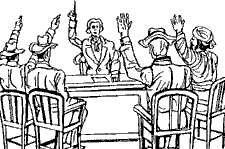
It was at the glittering durbar which was attended by Viceroy Lytton, maharajas and nawabs and intellectuals, that a man in 'homespun spotless white khadi' rose to read a citation on behalf of the Pune Sarvajanik Sabha. Ganesh Vasudev Joshi put forth a demand couched in very polite language: "We beg of Her Majesty to grant to India the same political and social status as is enjoyed by her British subjects." With this demand, it can be said that the campaign for a free India was formally launched at the very durbar where the Queen of England was proclaimed the Empress of India.
| |||||
Dimdima is the Sanskrit word for ‘drumbeat’. In olden days, victory in battle was heralded by the beat of drums or any important news to be conveyed to the people used to be accompanied with drumbeats.
Bharatiya Vidya Bhavan
K. M Munshi Marg,
Chowpatty, Mumbai - 400 007
email : editor@dimdima.com
Bharatiya Vidya Bhavan
505, Sane Guruji Marg,
Tardeo, Mumbai - 400 034
email : promo@dimdima.com
Dimdima.com, the Children's Website of Bharatiya Vidya Bhavan launched in 2000 and came out with a Printed version of Dimdima Magazine in 2004. At present the Printed Version have more than 35,000 subscribers from India and Abroad.