Dimdima
Online Children's Magazine from India
Dimdima
Online Children's Magazine from India




The Communists came to power in Mongolia in 1921 and ruled for 75 years until voted out in last June's elections.
Forced industrialisation made them change their way of life, but now free to think and choose for themselves, Mongolians are taking a new look at their past. There is a revival of interest in Buddhism which the Communists had tried to suppress and a renewed pride in the great Mongol warrior, Genghis Khan.
When Genghis Khan was a boy, the Mongol nation consisted of a number of loosely affiliated nomadic tribes. In time, Timujin, as the warrior was then known, united the tribes and forged them into a mighty fighting force. He then set out to conquer the world. By the time of his death in 1227, the Mongol empire stretched from the Pacific to eastern Europe. It was the largest land empire in history.
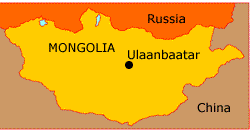
Today Mongolia lies forgotten, sealed off from the rest of the world by its giant neighbours, Russia and China.
Most Mongolians now live on livestock farms or in towns and cities. But a few still live a nomadic existence like their forefathers. They live in tents called gers and move from place to place with their animals.
The capital of the country is Ulan Bator which means 'Red Hero'.
Last updated on :5/26/2021
FLAG

Area : 1,566,500 sq km
Capital : Ulaanbaatar
Population : 2,751,314
Language : Mongolian
Currency : tugrik(1,110 tugriks equal U.S.$1; 2002 average)
Dimdima is the Sanskrit word for ‘drumbeat’. In olden days, victory in battle was heralded by the beat of drums or any important news to be conveyed to the people used to be accompanied with drumbeats.
Bharatiya Vidya Bhavan
K. M Munshi Marg,
Chowpatty, Mumbai - 400 007
email : editor@dimdima.com
Bharatiya Vidya Bhavan
505, Sane Guruji Marg,
Tardeo, Mumbai - 400 034
email : promo@dimdima.com
Dimdima.com, the Children's Website of Bharatiya Vidya Bhavan launched in 2000 and came out with a Printed version of Dimdima Magazine in 2004. At present the Printed Version have more than 35,000 subscribers from India and Abroad.