
Dimdima
Online Children's Magazine from India
Dimdima
Online Children's Magazine from India






Space Exploration
Apollo 9 tested the Lunar Module in the safety of Earth’s orbit. Later Apollo 10, going into Moon orbit, conducted a full dress rehearsal of the moon landing without actually landing on it. The Lunar Module, piloted by two astronauts dropped to within 15 kilometres of the Moon’s surface before returning to the mother ship.
The spacecraft that was scheduled to make the historic trip to the Moon was Apollo 11. On July 16, 1969, a Saturn V rocket carrying Apollo 11 rose gracefully into the air from Cape Canaveral. Its crew consisted of three experienced astronauts: Neil Armstrong, Michael Collins and Edwin Aldrin.
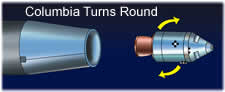
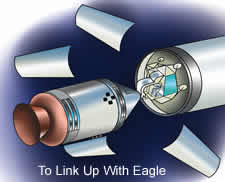 Barely 12 minutes after launch the spacecraft was in orbit. After one and a half orbits of Earth during which all the spacecraft’s systems were checked to ensure that they worked properly, the third stage of the Saturn V was fired to send Apollo on its outward journey to the Moon. Shortly afterwards, the Command\ Service Module unit (the Command Module was called Columbia) separated from the Saturn third stage, turned around and connected nose to nose with the Lunar Module that had been stored in the top of the third stage, below the Command and Service modules. Then, with the Lunar Module (called Eagle) attached to its nose, Columbia drew away from the third stage and continued towards the Moon. On nearing the Moon 2 1\2 days later, Apollo fired its Service Module rocket to go into lunar orbit.
EXPLORE MORE...
Get Help or Give Help.
- Do you have a Science Question?
- Post it here and get the answer.
- Some questions posted by others are not yet answered.
- View those questions and answer them.
Dimdima is the Sanskrit word for ‘drumbeat’. In olden days, victory in battle was heralded by the beat of drums or any important news to be conveyed to the people used to be accompanied with drumbeats.
Bharatiya Vidya Bhavan
K. M Munshi Marg,
Chowpatty, Mumbai - 400 007
email : editor@dimdima.com
Bharatiya Vidya Bhavan
505, Sane Guruji Marg,
Tardeo, Mumbai - 400 034
email : promo@dimdima.com
Dimdima.com, the Children's Website of Bharatiya Vidya Bhavan launched in 2000 and came out with a Printed version of Dimdima Magazine in 2004. At present the Printed Version have more than 35,000 subscribers from India and Abroad.