
Dimdima
Online Children's Magazine from India
Dimdima
Online Children's Magazine from India






The Kaveri is joined by a tributary, the Kabini or Kapila, about 12 km south of Somanathapura. The town of Tirumakudlu Narasipura stands at the confluence. The name is a corruption of Thiruma(three) and Kudulu(confluence). The third is the Sphatika Sarovara, which is believed to be a subterranean lake. T. Narasipura is a major pilgrimage centre, with a medieval temple dedicated to the sage Agastya.
Some distance away from T. Narasipura, on the left bank of the Kaveri, is the desolate, sand-blown town of Talakadu. Once it was the thriving capital of the Ganga dynasty. Then came the Cholas, who named it Rajarajapuram, and then the Hoysalas under Vishnuvardhana. But now, Talakadu lies buried under huge moving sand dunes, that are as high as 15m in places. According to a semi-historical story, Talakadu's fate is due to a curse pronounced on the city by Alamelamma, the widow of Tirumalaraya, the last viceroy of the Vijayanagara king in Srirangapatna. Raja Wodeyar, the ruler of Mysore, coveted the fabulous jewels owned by Alamelamma and sent his soldiers to obtain them by force, taking advantage of her husband's death. Alamelamma fled to Malangi, on the opposite bank of the Kaveri from Talakadu but when her pursuers closed in on her, jumped into the river with her jewels. Before the waters swallowed her, she is said to have cried out aloud: "May Talakadu be always covered with sand; may there always be a whirlpool in the Kaveri at Malangi and may the kings of Mysore always remain without heirs!"
The locals fearfully point out that the curse has come true: Talakadu has mysteriously been covered by sand, there is a whirlpool at Malangi and the family tree of the Mysore rulers shows a large number of adopted heirs.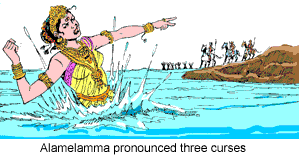
Last updated on :11/3/2003
Dimdima is the Sanskrit word for ‘drumbeat’. In olden days, victory in battle was heralded by the beat of drums or any important news to be conveyed to the people used to be accompanied with drumbeats.
Bharatiya Vidya Bhavan
K. M Munshi Marg,
Chowpatty, Mumbai - 400 007
email : editor@dimdima.com
Bharatiya Vidya Bhavan
505, Sane Guruji Marg,
Tardeo, Mumbai - 400 034
email : promo@dimdima.com
Dimdima.com, the Children's Website of Bharatiya Vidya Bhavan launched in 2000 and came out with a Printed version of Dimdima Magazine in 2004. At present the Printed Version have more than 35,000 subscribers from India and Abroad.