
Dimdima
Online Children's Magazine from India
Dimdima
Online Children's Magazine from India






The Moon Gets a Punch!
After the success of the Sputnik missions (seven Sputnik satellites were launched after the first two which astonished the world), the Soviet Union turned its attention to the exploration of the moon.
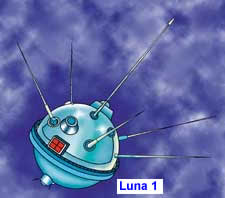
 The first of the Luna series of spacecraft was launched by the Soviets, on 2 January 1959. Luna 1 was the first spacecraft ever to achieve escape velocity (about 40,000 km/h). Breaking free from Earth’s gravity it let itself be drawn by the gravity of the moon, and passed within 6,000 kilometres of the lunar surface.
Luna 2, launched on September 12 of the same year, actually hit the moon, becoming the first manmade object to reach another world.
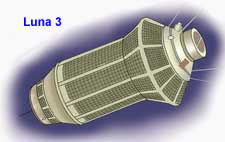
On October 4, 1959, two years to the day of the launch of Sputnik 1, another historic probe was launched from the Soviet Union. This was Luna 3 whose mission was to photograph the far side of the moon — the side that had never been seen by man because the moon keeps one face turned permanently towards Earth.
Swinging round the moon, Luna 3 passed 6200 kilometres above its surface, snapping 29
pictures of its hidden side. The pictures were developed on board and transmitted to Earth by radio. These first views of the lunar far side showed mountainous terrain, very different from the near side, and two dark regions, which were named the ‘Sea of Moscow’, and the ‘Sea of Dreams’.
The United States, determined to catch up with the Soviet Union in space achievements, had launched 18 spacecraft to the Soviet Union’s 6, by the end of 1959, but the Soviets were clearly streets ahead.
EXPLORE MORE...
Get Help or Give Help.
- Do you have a Science Question?
- Post it here and get the answer.
- Some questions posted by others are not yet answered.
- View those questions and answer them.
Dimdima is the Sanskrit word for ‘drumbeat’. In olden days, victory in battle was heralded by the beat of drums or any important news to be conveyed to the people used to be accompanied with drumbeats.
Bharatiya Vidya Bhavan
K. M Munshi Marg,
Chowpatty, Mumbai - 400 007
email : editor@dimdima.com
Bharatiya Vidya Bhavan
505, Sane Guruji Marg,
Tardeo, Mumbai - 400 034
email : promo@dimdima.com
Dimdima.com, the Children's Website of Bharatiya Vidya Bhavan launched in 2000 and came out with a Printed version of Dimdima Magazine in 2004. At present the Printed Version have more than 35,000 subscribers from India and Abroad.