Dimdima
Online Children's Magazine from India
Dimdima
Online Children's Magazine from India





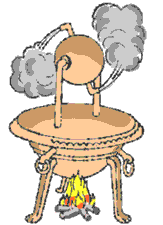
Heron, an ancient Greek geometer and engineer from Alexandria made the first steam engine- called "aeolipile," which means "wind ball" in Greek .
How did the aeolipile work ? A sealed pot filled with water was placed over the fire. The steam generated from the pot would flow to a spherical ball of metal through two tubes. The ball had two curved outlets to let out the steam, As the steam was vented out, the ball would rotate.
Heron used this devise as nothing more than a toy, although some of his books do mention its use to open temple doors. Years later, early text books also mentioned the use of the aeolipile for use in a horseless carriage. However, this technology did not have sufficient power to run a carriage.
This primitive device, invented in the first century AD, was the precursor to the inventions of today. Based on this principle, Dionysius Papin published plans for a high-pressure steam engine, in 1690. Thomas Savery built the first steam engine in 1698, which was then refined by James Watt in 1780 to create the powerful steam engine, we all know of. The invention of the steam engine by James Watt was responsible for the industrial revolution that started in Europe and changed the human life on earth in a way that was unimaginable a few years back.
EXPLORE MORE...
Get Help or Give Help.
- Do you have a Science Question?
- Post it here and get the answer.
- Some questions posted by others are not yet answered.
- View those questions and answer them.
Dimdima is the Sanskrit word for ‘drumbeat’. In olden days, victory in battle was heralded by the beat of drums or any important news to be conveyed to the people used to be accompanied with drumbeats.
Bharatiya Vidya Bhavan
K. M Munshi Marg,
Chowpatty, Mumbai - 400 007
email : editor@dimdima.com
Bharatiya Vidya Bhavan
505, Sane Guruji Marg,
Tardeo, Mumbai - 400 034
email : promo@dimdima.com
Dimdima.com, the Children's Website of Bharatiya Vidya Bhavan launched in 2000 and came out with a Printed version of Dimdima Magazine in 2004. At present the Printed Version have more than 35,000 subscribers from India and Abroad.