Dimdima
Online Children's Magazine from India
Dimdima
Online Children's Magazine from India




The Chinese first spotted one of the “dirty snowballs” way back in 1059 BC. The long “tail” earned them the name comets - derived from the Latin word Cometa meaning "long-haired”. Unlike other small bodies in the solar system, comets have been known since antiquity. Scientists think that about 100 million comets orbit the Sun. But from the first documented comet, to today, only a few hundreds of comets have been catalogued.
But what are comets? Comets are sometimes called dirty snowballs or "icy mudballs". They are a mixture of ices (both water and frozen gases) and dust that for some reason didn't get incorporated into planets when the solar system was formed. They are thus believed to be the debris left after the formation of the Sun and planets in our solar system.
With no light of their own, comets are invisible except when they are near the Sun. Many of them have a definite path through the solar system and are sighted periodically from Earth. Halley's Comet is the most famous of them. It makes an appearance once every 76 years. This comet was named after Sir Edmond Halley, who first spotted it. Most comets however have highly eccentric orbits, which take them far away into space; they are seen once and then disappear for millennia.
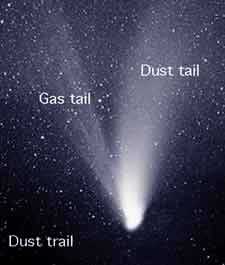
When the comet goes close to the sun, solar heat causes the outer layers of the comet to evaporate. Dust and gases are released which the solar winds push away causing them to stream off into space to form the comet's tail. The comets tail forms its identifying feature, some tails reaching 150 million kilometers in length!
Each time a comet passes close to the Sun, it loses some of its material. Over time, it breaks up and disappears completely. After 500 or so passes near the Sun, most of a comet's ice and gas is lost leaving a rocky object very much like an asteroid in appearance. It is believed that perhaps half of the near-Earth asteroids may actually be "dead" comets
EXPLORE MORE...
Get Help or Give Help.
- Do you have a Science Question?
- Post it here and get the answer.
- Some questions posted by others are not yet answered.
- View those questions and answer them.
Dimdima is the Sanskrit word for ‘drumbeat’. In olden days, victory in battle was heralded by the beat of drums or any important news to be conveyed to the people used to be accompanied with drumbeats.
Bharatiya Vidya Bhavan
K. M Munshi Marg,
Chowpatty, Mumbai - 400 007
email : editor@dimdima.com
Bharatiya Vidya Bhavan
505, Sane Guruji Marg,
Tardeo, Mumbai - 400 034
email : promo@dimdima.com
Dimdima.com, the Children's Website of Bharatiya Vidya Bhavan launched in 2000 and came out with a Printed version of Dimdima Magazine in 2004. At present the Printed Version have more than 35,000 subscribers from India and Abroad.