
Dimdima
Online Children's Magazine from India
Dimdima
Online Children's Magazine from India




The artist scientist
| Date of Birth-Death :1791-1872 |
| Country of Birth :USA |
| Major Invention:Telegraph |
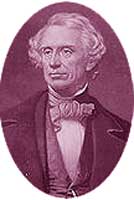
Samuel Morse, was born in Massachusetts, USA. He started off his career after his graduation as a painter and sculptor. He even earned a gold medal from the famous Adelphi Society of Arts for his first effort in sculpture, the "Dying Hercules." He became the first president of the National Academy of Design, and was appointed Professor of the Arts of Design in the University of the city of New York.
Yet, this painter, turned to inventing to make his fortune during a sea voyage. On this journey, Samuel Morse heard about many attempts to create usable telegraphs. He was fascinated by this problem and began to study books on physics for two years to acquire scientific knowledge. He realized that pulses of electrical current could carry information over wires.
Thus the world's first working model of a telegraph was born. His signaling device was quite simple. It consisted of a transmitter (containing a battery and a key), a small buzzer as a receiver and a pair of wires connecting the two. Samuel Morse improved it by adding a second switch and a second buzzer to enable transmission in the opposite direction as well.
On May 24, 1844 Samuel Morse sent the first electronic message between Baltimore and Washington: "What hath God wrought," or in other words, "Look what God has enabled us to build, and benefit by."
By 1861 the two coasts of the United States were linked by telegraph.
Telegraph continued to enjoy the status of being the fastest and reliable mode of communication for almost 140 years since its first inception.
EXPLORE MORE...
Get Help or Give Help.
- Do you have a Science Question?
- Post it here and get the answer.
- Some questions posted by others are not yet answered.
- View those questions and answer them.
Dimdima is the Sanskrit word for ‘drumbeat’. In olden days, victory in battle was heralded by the beat of drums or any important news to be conveyed to the people used to be accompanied with drumbeats.
Bharatiya Vidya Bhavan
K. M Munshi Marg,
Chowpatty, Mumbai - 400 007
email : editor@dimdima.com
Bharatiya Vidya Bhavan
505, Sane Guruji Marg,
Tardeo, Mumbai - 400 034
email : promo@dimdima.com
Dimdima.com, the Children's Website of Bharatiya Vidya Bhavan launched in 2000 and came out with a Printed version of Dimdima Magazine in 2004. At present the Printed Version have more than 35,000 subscribers from India and Abroad.