Dimdima
Online Children's Magazine from India
Dimdima
Online Children's Magazine from India





Stars shine bright because of the tremendous amount of energy they are producing continuously. The mechanism of energy production in stars is nuclear fusion, two hydrogen atoms inside the star fuse together creating helium atom and in this process a huge amount of energy is released, the energy is released from the star as light and heat.
Stars like our sun, burn the large amounts of hydrogen present in their core, and convert it into helium. In another 5 billion years, the Sun will have used up all the hydrogen in its core. What will happen to the Sun after that ? It will become a “white dwarf”.
What are white dwarfs? White dwarfs are the remains of stars that have burned out ( that it has used up most of its fuel, hydrogen), the hot gas generated in its core has pushed to come out for millions of years eventually leaving behind the core. This exposed core is a white dwarf. A white dwarf surrounded by the last remains of the expanding gas from its core is a nebula.
White dwarfs are very small and thus very hard to detect. If a star seems to have some sort of unexplained motion, we may find that the single star is not actually alone. A closer observation very often reveals that it has a white dwarf companion. The first white dwarf ever to be discovered was found as a companion star to Sirius, a bright star near the constellation Canis Major. (The great bear) by astronomer Friedrich Bessel in 1844.
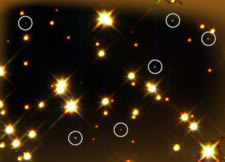
The Hubble Space Telescope has helped view more than 75 white dwarfs in one constellation alone. These white dwarfs were so faint that the brightest of them was not even as bright as a 100 watt light bulb seen at the moon's distance (from earth). This constellation called Scorpius where so many white dwarfs were detected, is approximately 14 billion years old, which is why so many of its stars are near the end of their lives.
EXPLORE MORE...
Get Help or Give Help.
- Do you have a Science Question?
- Post it here and get the answer.
- Some questions posted by others are not yet answered.
- View those questions and answer them.
Dimdima is the Sanskrit word for ‘drumbeat’. In olden days, victory in battle was heralded by the beat of drums or any important news to be conveyed to the people used to be accompanied with drumbeats.
Bharatiya Vidya Bhavan
K. M Munshi Marg,
Chowpatty, Mumbai - 400 007
email : editor@dimdima.com
Bharatiya Vidya Bhavan
505, Sane Guruji Marg,
Tardeo, Mumbai - 400 034
email : promo@dimdima.com
Dimdima.com, the Children's Website of Bharatiya Vidya Bhavan launched in 2000 and came out with a Printed version of Dimdima Magazine in 2004. At present the Printed Version have more than 35,000 subscribers from India and Abroad.