Dimdima
Online Children's Magazine from India
Dimdima
Online Children's Magazine from India






The First Guided Missiles

In 1898, a Russian physicist named Konstantin Tsiolkovsky (1857-1935) suggested that rockets could be used to travel to outer space. In those days all rockets were powered by solid fuel (chemical powders). Tsiolkovsky theorized that the use of liquid fuel would increase the range of the rockets. Tsiolkovsky is sometimes called the father of modern astronautics because of his pioneering work in space exploration.
The American scientist Robert Goddard made  the next significant advance in the field of rocketry. On 16 March 1926, Goddard fired a rocket 12.5m into the air from a farm in Auburn, Massachussetts. The rocket was powered by liquid fuel (petrol and liquid oxygen).
Earlier in Europe, in 1917, the German physicist Hermann Oberth had also suggested a liquid–fuel propelled rocket. Oberth had been fascinated by the possibility of space travel from an early age. 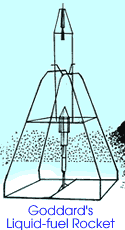 In 1923 he wrote a book, ‘The Rocket Into Interplanetary Space’ which awakened an interest in space travel, in Germany. However it also attracted the attention of the German government, which began research in rockets in 1935. The research became intensified in the war years (1939-45), and culminated in the development of the world’s first rocket powered guided missiles: the V-1 and the V-2.
The V-1 travelled at a speed of about 580 kilometres per hour, and could be heard approaching by the people of the target cities; the more 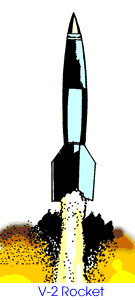 advanced V-2 was twice the length of the V-1 and travelled at a speed of about 5,300 kilometres per hour, more than four times the speed of sound, to hit targets all over Europe. More than a thousand rained down on London and on the Belgian port of Antwerp, causing great destruction and loss of life.
The V-2 was an awesome weapon but it occurred to some people that it could be adapted for space travel.
EXPLORE MORE...
Get Help or Give Help.
- Do you have a Science Question?
- Post it here and get the answer.
- Some questions posted by others are not yet answered.
- View those questions and answer them.
Dimdima is the Sanskrit word for ‘drumbeat’. In olden days, victory in battle was heralded by the beat of drums or any important news to be conveyed to the people used to be accompanied with drumbeats.
Bharatiya Vidya Bhavan
K. M Munshi Marg,
Chowpatty, Mumbai - 400 007
email : editor@dimdima.com
Bharatiya Vidya Bhavan
505, Sane Guruji Marg,
Tardeo, Mumbai - 400 034
email : promo@dimdima.com
Dimdima.com, the Children's Website of Bharatiya Vidya Bhavan launched in 2000 and came out with a Printed version of Dimdima Magazine in 2004. At present the Printed Version have more than 35,000 subscribers from India and Abroad.